
How the Gym Can Improve Your Mental Health, Cognitive Function, and Fight Depression
The gym is more than just building muscle, losing weight, or chasing numbers on the barbell. Training can become therapy. It can become structure. It can become the one place where your mind finally slows down and locks in. In today’s world, more people are dealing with stress, anxiety, depression, brain fog, burnout, and emotional exhaustion than ever before. A lot of people are mentally drained before they even start their day. That’s where fitness, nutrition, and discipline can completely change somebody’s life. As somebody who has spent years under heavy weight, I can honestly say this: lifting weights doesn’t just build your body—it builds your mind too.
Ronnell "Kilo Nellz" Leftwich
5/14/20263 min read
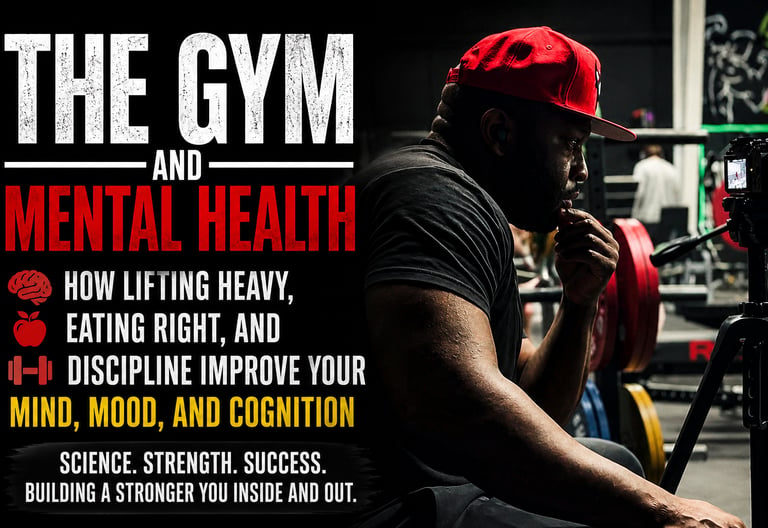
Exercise and Mental Health: The Science Behind It
Scientific research continues to show a strong connection between exercise and improved mental health. Resistance training and cardiovascular exercise have both been linked to reduced symptoms of depression, anxiety, and chronic stress.
When you train hard, your body releases chemicals called endorphins, dopamine, and serotonin. These are neurotransmitters that play a major role in mood regulation, motivation, focus, and emotional balance.
This is one reason why many people feel mentally clearer and emotionally lighter after a hard workout.
Heavy lifting and exercise can also help regulate the body’s HPA axis (Hypothalamic-Pituitary-Adrenal axis), which controls your stress response system. Chronic stress can keep cortisol levels elevated for long periods of time, which negatively impacts sleep, recovery, mood, and cognitive performance. Exercise helps the body manage that stress response more efficiently.
How Lifting Weights Improves Cognitive Function
Strength training does more than build muscle tissue. It can also improve brain performance and cognitive abilities.
Studies suggest that resistance training may help support:
Better memory retention
Increased focus and concentration
Improved reaction time
Mental clarity
Reduced brain fog
Higher levels of cognitive resilience
Exercise has also been connected to neuroplasticity, which is the brain’s ability to adapt, grow, and create new neural connections. In simple terms, training can help keep your mind sharper and more adaptable over time.
That’s one reason why many successful people train consistently. The discipline, structure, and mental sharpness from the gym carry over into everyday life.
Fighting Depression Through Fitness
One of the hardest things about depression is that it can make people feel stuck physically, mentally, emotionally, and spiritually. The gym can become a tool to fight back against that feeling.
Training gives people:
Structure and routine
A sense of accomplishment
Daily goals
Increased confidence
A healthy outlet for stress and frustration
Improved sleep quality
Better energy levels
Sometimes the hardest part is simply showing up. But once you get moving, you start rebuilding momentum mentally.
Even something as simple as finishing a workout can create a psychological victory. You proved to yourself that you showed up despite how you felt.
That matters.
Nutrition and Mental Performance
Your nutrition directly affects your brain function and mental health.
If you constantly feed your body processed foods, excessive sugar, alcohol, and low-quality nutrients, your energy and mental clarity will suffer. On the other hand, eating quality protein, healthy fats, fruits, vegetables, and staying hydrated can significantly improve mental performance and mood stability.
Your brain requires proper nutrients to function efficiently.
Foods rich in omega-3 fatty acids, amino acids, vitamins, and minerals may help support neurotransmitter function and overall brain health. Proper nutrition can also help stabilize energy levels throughout the day, reducing crashes and irritability.
Simply put: your mind performs better when your body is fueled correctly.
Heavy Lifting Builds Mental Toughness
There’s something different about putting heavy weight on your back or pulling heavy weight from the floor. Heavy lifting forces you to confront discomfort directly.
You learn how to stay calm under pressure.
You learn how to focus.
You learn how to push through fear and doubt.
That mental toughness starts carrying over into life outside the gym too.
The discipline required to consistently train, recover, and eat correctly builds confidence and self-respect over time. You stop viewing obstacles the same way because training teaches you how to endure difficult situations without folding mentally.
The Gym Can Become Therapy
For many people, the gym becomes a safe place mentally.
A place where the noise disappears.
A place where stress gets released.
A place where frustration turns into focus.
Some people go to therapy.
Some people meditate.
Some people lift weights.
And honestly, a lot of people need all three.
There’s nothing weak about prioritizing your mental health. Taking care of your mind is just as important as taking care of your body.
Final Thoughts
The gym will not magically solve every mental health issue overnight. But it can absolutely become one of the strongest tools in helping somebody regain confidence, clarity, structure, discipline, and emotional stability.
Training hard.
Eating correctly.
Sleeping better.
Staying disciplined.
All of those things work together to improve not only your physical health, but your mental health too.
Sometimes the strongest thing a person can do is keep showing up.
And sometimes that first workout becomes the beginning of changing your entire life.
Ready to build both your body and your mindset? Check out the training programs available at https://payhip.com/KiloNellzTraining and start leveling up mentally and physically.