
How to Improve Your Squat: Build Strength, Power, and Better Technique
If you want a bigger squat, you can’t just throw more weight on the bar and hope for the best. A strong squat is built through proper technique, consistency, mobility, recovery, and smart training. Whether you’re a beginner trying to hit depth correctly or a competitive powerlifter chasing bigger numbers, improving your squat takes intent and discipline every single session. The squat is more than just a leg exercise. It develops full-body strength, builds explosiveness, improves athleticism, and exposes weaknesses mentally and physically. The better your squat gets, the stronger your entire foundation becomes.
Ronnell "Kilo Nellz" Leftwich
5/12/20263 min read
My Squat Philosophy
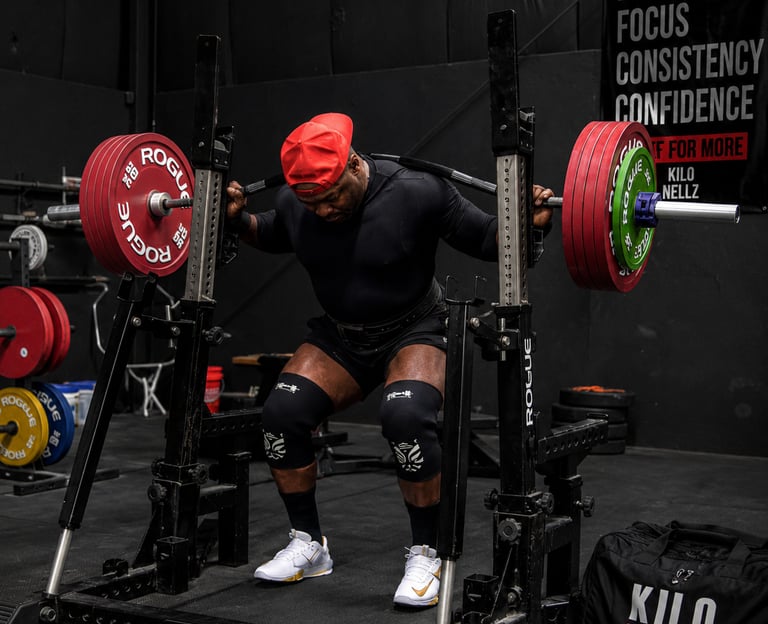
One thing I strongly believe when it comes to squatting is that your power should come straight through your heels.
When I squat, I focus on driving through my heels while still grabbing the ground with my toes. Your toes help stabilize and grip the floor, but the real power is being transferred straight through your heels, through your legs, and up through your body. That’s where the drive comes from.
A lot of people create knee issues because they let their knees shoot too far forward too early in the movement. Instead of starting the squat by bending your knees first, I believe the first movement should be your hips going back.
Sit back into the squat.
As your hips move back, your body naturally begins to open up into position. From there, you stay tight, controlled, and loaded so you can drive upward while still staying mechanically sound.
Another big mistake people make is trying to “jump” the weight up out of the hole. Instead of jerking or bouncing upward, think about squeezing your way up through the squat. Stay controlled and powerful at the same time.
That tension is what helps keep you strong, stable, and efficient under heavy weight.
Another major part of my squat philosophy is keeping your head, neck, and back all neutral with each other.
A lot of lifters lose positioning because their eyes are moving all over the place during the rep. When your eyes move around, your head position changes, and once your head position changes, it can throw off the alignment of your neck and spine.
I like keeping my eyes fixed on one spot the entire time while slightly looking downward at an angle. That helps keep the head neutral with the neck and the back so everything stays stacked together properly.
The more neutral and controlled your body stays, the more efficiently you can transfer force through the lift.
When your head, neck, and spine stay aligned together, you’ll usually feel more balanced, more stable, and stronger throughout the entire squat movement.
Fix Your Technique First
Before worrying about adding more weight to the bar, focus on mastering your movement.
Your squat starts before you even unrack the weight. Get your feet planted, brace your core hard, tighten your upper back, and stay locked in from the walkout to the last rep.
A few important squat cues:
Drive through your heels
Grip the floor with your toes
Sit back into the squat
Let the hips move first
Keep your knees from shooting too far forward
Keep your eyes fixed on one point
Maintain a neutral head, neck, and spine position
Stay tight through your core
Squeeze up through the weight instead of bouncing
Most squat issues come from losing positioning, losing tension, or rushing the movement.
The tighter and more controlled you stay, the stronger your squat becomes.
Build Your Posterior Chain
Your squat will only get so far if your posterior chain is weak.
Your glutes, hamstrings, hips, lower back, and core all play a huge role in stabilizing and driving the squat. Weakness in these areas often causes lifters to lose tightness, shift out of position, or struggle coming out of the bottom of the lift.
Some of the best exercises to improve your squat include:
Romanian deadlifts
Good mornings
Pause squats
Split squats
Leg press
Reverse hypers
Hamstring curls
Front squats
These movements help strengthen the muscles that directly carry over to bigger and safer squats.
Train With Control
One of the fastest ways to stall your squat progress is rushing every rep.
Controlled reps help you stay in position, maintain tension, and move more efficiently under heavier weight. The goal isn’t to dive bomb the squat or bounce recklessly out of the hole. The goal is to stay tight and apply force correctly from start to finish.
Control builds consistency.
Consistency builds strength.
Recovery Matters More Than People Think
A stronger squat is built outside the gym too.
If your recovery is poor, your progress will eventually stall no matter how hard you train. Sleep, hydration, nutrition, and stress management all directly affect your performance under the bar.
To recover better:
Eat enough protein and carbohydrates
Get quality sleep consistently
Warm up properly before training
Don’t max out every week
Take recovery seriously instead of treating it like an afterthought
The strongest lifters aren’t just training hard — they’re recovering hard too.
Consistency Beats Motivation
You won’t improve your squat from random bursts of motivation.
The lifters who build elite squats are the ones who keep showing up, even on days they don’t feel like training. Progress comes from stacking good sessions over time.
Some workouts will feel amazing. Some will feel terrible. Both still count.
Your squat grows when discipline takes over after motivation fades.
Final Thoughts
Improving your squat is a long-term process. Focus on mastering technique, strengthening weak areas, staying consistent, and respecting recovery. Small improvements over time turn into major strength gains later.
Every rep matters. Every session matters.
Prepare. Perform. Dominate.
Ready to take your squat to the next level?
Check out the training programs available at https://payhip.com/b/BN3tJ and start building real strength with purpose.