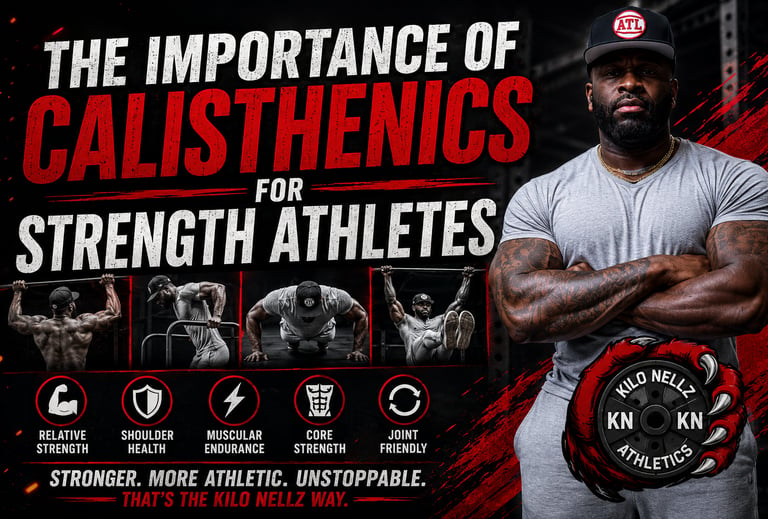
The Importance of Calisthenics for Strength Athletes
When most people think about building strength, they immediately think about barbells, dumbbells, and heavy weights. As a powerlifter and strength athlete, I understand why. Squats, bench presses, deadlifts, rows, and overhead presses are some of the best exercises ever created for building strength and muscle. However, there is one training method that many strength athletes overlook: calisthenics. Calisthenics refers to exercises that use your bodyweight as resistance. Movements such as push-ups, pull-ups, chin-ups, dips, bodyweight squats, planks, and hanging leg raises have been used for decades to build strength, athleticism, and muscular endurance. Many lifters assume bodyweight exercises become useless once you get strong enough to move heavy weights. I disagree. In fact, calisthenics can provide several benefits that complement heavy strength training and help athletes become more well-rounded
Ronnell "Kilo Nellz" Leftwich
5/29/20262 min read
Calisthenics Build Relative Strength
One of the biggest benefits of calisthenics is improving relative strength.
Absolute strength refers to how much weight you can lift. Relative strength refers to how strong you are compared to your body weight.
A powerlifter may be able to squat 700 pounds, but if they struggle to perform a few pull-ups, there may be room to improve relative strength.
Exercises like pull-ups, chin-ups, dips, and push-ups force you to control your own body through space. This develops strength that transfers into athletics, daily life, and overall movement quality.
Improved Shoulder Health and Stability
Heavy pressing is essential for building a bigger bench press, but it can also place significant stress on the shoulders over time.
Bodyweight exercises can help strengthen many of the smaller stabilizing muscles around the shoulder joint.
Pull-ups, chin-ups, and properly performed push-ups encourage healthy shoulder movement and stability. They can help balance some of the repetitive stress that comes from heavy barbell pressing.
A stronger, healthier shoulder is often a more durable shoulder.
Increased Muscular Endurance
Strength athletes often train in lower rep ranges. While this is great for maximizing strength, muscular endurance can sometimes be neglected.
Bodyweight exercises allow athletes to accumulate more volume without constantly loading the joints with heavy weight.
High-rep push-ups, dips, pull-ups, and bodyweight circuits can improve work capacity and conditioning while still contributing to muscle development.
The better your work capacity, the more training volume you can handle over time.
Better Core Strength
Many calisthenic exercises require significant core engagement.
Pull-ups, hanging leg raises, planks, push-ups, and bodyweight squats all force the core to stabilize the body during movement.
A stronger core helps improve performance in nearly every major lift.
Whether you’re squatting, deadlifting, bench pressing, or overhead pressing, your ability to create and maintain stability matters.
Joint-Friendly Training
Heavy lifting is effective, but it can also be demanding on the joints and nervous system.
Calisthenics can provide a way to continue training hard while reducing overall stress on the body.
Many athletes use bodyweight exercises during deload weeks, recovery sessions, or lighter training days.
This allows them to stay active and continue building fitness without constantly pushing maximum loads.
Calisthenics Can Build Muscle Too
Some people assume bodyweight training cannot build muscle.
That simply isn’t true.
Push-ups, dips, pull-ups, chin-ups, lunges, and single-leg bodyweight exercises can all stimulate muscle growth when performed with enough intensity and volume.
In fact, many athletes have built impressive physiques using little more than bodyweight exercises.
While adding external resistance may eventually be necessary for advanced athletes, bodyweight training remains a powerful muscle-building tool.
The Best Calisthenic Exercises for Strength Athletes
If you’re a strength athlete looking to add calisthenics into your routine, start with these movements:
Pull-Ups
Chin-Ups
Dips
Push-Ups
Hanging Leg Raises
Planks
Bodyweight Squats
Walking Lunges
Inverted Rows
Pike Push-Ups
These exercises require minimal equipment and can provide tremendous benefits when combined with a solid strength training program.
Final Thoughts
Calisthenics should not replace heavy strength training for athletes whose primary goal is maximizing strength. However, they can be an excellent addition to a well-rounded program.
Bodyweight exercises help improve relative strength, muscular endurance, shoulder health, core stability, work capacity, and overall athleticism. They are simple, effective, and have stood the test of time for a reason.
The strongest athletes are not always the ones who can move the most weight. Often, they are the athletes who can combine strength, control, stability, and athleticism into one complete package.
If you’re serious about becoming stronger, don’t overlook the value of mastering your own bodyweight.