
The Science of Music and Exercise
Walk into almost any gym and you’ll notice one thing immediately: people are wearing headphones. Whether it’s hip-hop, rock, EDM, classical music, or motivational speeches mixed with music, most people instinctively reach for something to listen to before they train. While many people assume music is simply there for entertainment, science tells a much different story. Research has consistently shown that music can improve athletic performance, increase motivation, reduce perceived effort, enhance focus, and even influence the way your brain processes fatigue. As someone who spends a lot of time under heavy barbells, I’ve experienced firsthand how the right song can completely change the energy of a workout. The interesting thing is that there are real physiological and neurological reasons behind that feeling. Let’s break down the science.
Ronnell "Kilo Nellz" Leftwich
6/1/20264 min read
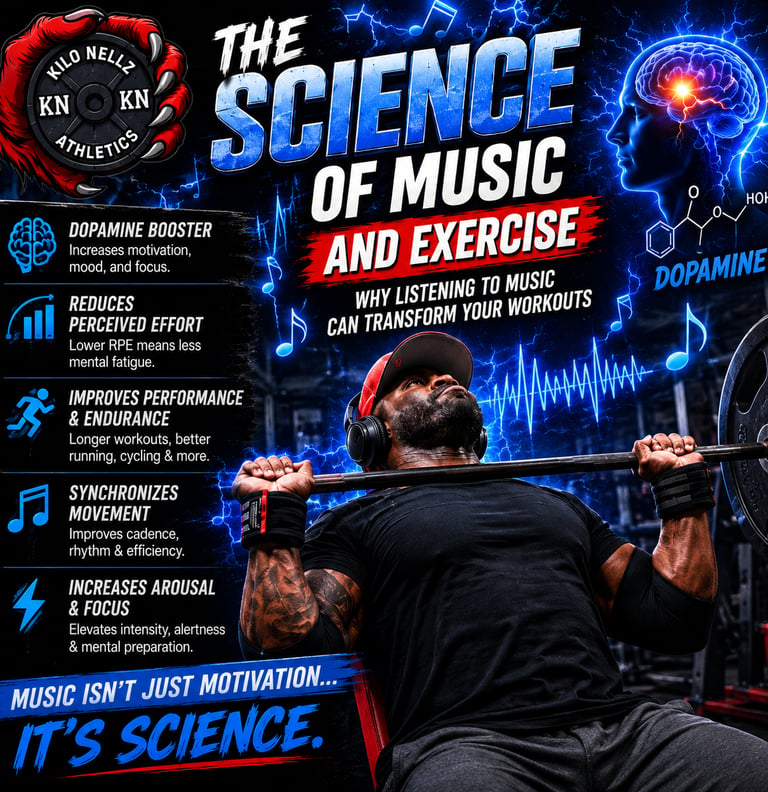
The Science of Music and Exercise: Why Listening to Music Can Improve Your Workouts
Walk into almost any gym and you’ll notice one thing immediately: people are wearing headphones.
Whether it’s hip-hop, rock, EDM, classical music, or motivational speeches mixed with music, most people instinctively reach for something to listen to before they train. While many people assume music is simply there for entertainment, science tells a much different story.
Research has consistently shown that music can improve athletic performance, increase motivation, reduce perceived effort, enhance focus, and even influence the way your brain processes fatigue.
As someone who spends a lot of time under heavy barbells, I’ve experienced firsthand how the right song can completely change the energy of a workout. The interesting thing is that there are real physiological and neurological reasons behind that feeling.
Let’s break down the science.
Music Increases Dopamine Production
One of the biggest benefits of listening to music during exercise is its effect on dopamine.
Dopamine is often referred to as the brain’s “reward chemical.” It plays a major role in motivation, pleasure, focus, and goal-directed behavior.
Research has shown that listening to enjoyable music can increase dopamine release in the brain, particularly within the nucleus accumbens, a region associated with reward and motivation.
When dopamine levels rise, you may experience:
Increased motivation
Improved mood
Better focus
Greater willingness to push through discomfort
Increased anticipation of reward
In simple terms, music can make you want to work harder.
This is one reason why many athletes have specific songs they listen to before a big lift, competition, or workout.
Music Can Reduce Perceived Effort
One of the most fascinating findings in exercise science is that music can make exercise feel easier.
Researchers often use a measurement called RPE (Rate of Perceived Exertion), which is essentially how hard an activity feels.
Studies have repeatedly shown that individuals listening to music often report lower RPE scores compared to those exercising without music.
The workload hasn’t changed.
The weight hasn’t changed.
The distance hasn’t changed.
But the brain perceives the effort differently.
This happens because music competes for your attention. Instead of focusing entirely on fatigue, muscle burn, or discomfort, part of your brain becomes engaged with rhythm, melody, and emotional processing.
As a result, exercise may feel less mentally taxing.
Music Can Improve Endurance Performance
Numerous studies have demonstrated improvements in endurance performance when music is present.
Athletes often experience:
Longer workout durations
Improved running performance
Increased cycling output
Greater exercise adherence
Researchers believe this occurs because music helps regulate pacing while simultaneously reducing mental fatigue.
When your mind becomes less focused on discomfort, you’re often able to sustain effort longer before reaching exhaustion.
Music Helps Synchronize Movement
The human brain naturally responds to rhythm.
This phenomenon is called auditory-motor synchronization.
Essentially, your body wants to move in time with a beat.
This synchronization can improve:
Running cadence
Walking pace
Cycling rhythm
Rowing efficiency
Repetitive exercise patterns
This is why many runners naturally match their stride to a song’s tempo.
The result is often improved movement efficiency and reduced energy expenditure.
Music Can Increase Arousal Levels
In sports psychology, arousal refers to the body’s state of readiness.
Before a heavy squat, deadlift, or bench press, athletes often seek to increase arousal.
The right music can stimulate the sympathetic nervous system, commonly known as the “fight or flight” response.
This can lead to:
Increased alertness
Elevated heart rate
Improved reaction time
Greater focus
Enhanced intensity
For powerlifters and strength athletes, this can be extremely beneficial when preparing for maximal or near-maximal attempts.
This is one reason aggressive music genres such as hip-hop, metal, and hard rock are commonly used before heavy lifts.
Music May Influence Hormonal Responses
Research suggests that enjoyable music may influence stress-related hormones.
Some studies have found reductions in cortisol levels after listening to preferred music.
Cortisol is often referred to as the body’s primary stress hormone.
Chronically elevated cortisol can contribute to:
Increased fatigue
Reduced recovery
Poor mood
Decreased performance
While music isn’t a miracle cure, creating a positive psychological state before and during training may help create a more favorable environment for performance.
Music Improves Focus and Concentration
One of the biggest challenges in modern gyms is distraction.
Phones.
Conversations.
Televisions.
People walking around.
Music acts almost like a mental filter.
By providing a consistent auditory stimulus, it helps many individuals block out external distractions and maintain focus on their workout.
For strength athletes, focus can directly impact:
Technique
Bar path
Breathing patterns
Mental preparation
Execution
The more focused you are, the more effective your training becomes.
What About Vibrations and Frequencies?
Many people discuss the idea that specific frequencies and vibrations may influence the body.
While there is growing research into sound therapy and vibration-based treatments, much of the stronger exercise-related evidence currently centers around psychological and neurological effects rather than mystical claims.
What we do know is that sound is vibration.
Every musical note creates vibrations that are processed by the auditory system and interpreted by the brain.
These vibrations influence emotional states, attention, memory, and physiological responses.
Certain tempos and styles of music may promote relaxation, while others may promote excitement and intensity.
The exact mechanisms continue to be studied, but the influence of sound on human physiology is undeniable.
Music and Strength Training
For strength athletes specifically, music can provide several unique benefits.
During heavy training sessions, music may:
Increase motivation
Improve focus
Reduce perceived fatigue
Enhance aggression when appropriate
Improve training enjoyment
Increase consistency
Perhaps most importantly, music can help create a psychological state that allows athletes to perform at their best.
Anyone who has ever hit a personal record while their favorite song was blasting through their headphones understands exactly what this feels like.
Final Thoughts
Music is far more than background noise.
Scientific research shows that music can influence motivation, dopamine production, focus, endurance, perceived effort, movement efficiency, and overall exercise performance.
While no playlist will replace proper programming, nutrition, recovery, or hard work, the right music can absolutely help you get more out of your training sessions.
As a strength athlete, I view music as another tool in the toolbox. Just like good technique, quality nutrition, and smart programming, music can help create an environment that allows you to perform at your highest level.
The next time you put on your headphones before a workout, remember that what you’re experiencing isn’t just motivation.
It’s science.