
Why Consistency Beats Intensity
Walk into almost any gym and you’ll see it. Someone is trying a crazy new exercise they saw online. Someone is maxing out every week. Someone is throwing weight around with questionable form because it looks impressive on camera. The fitness industry has become obsessed with intensity. The problem is that intensity by itself doesn’t guarantee results. In fact, intensity without direction is often one of the fastest ways to slow down your progress, burn yourself out, or get injured. I believe one of the biggest mistakes people make is being more performative with their intensity than productive with their training. A lot of people want to look like they’re training hard instead of actually training smart. There’s a difference.
Ronnell "kilo Nellz" Leftwich
5/27/20263 min read
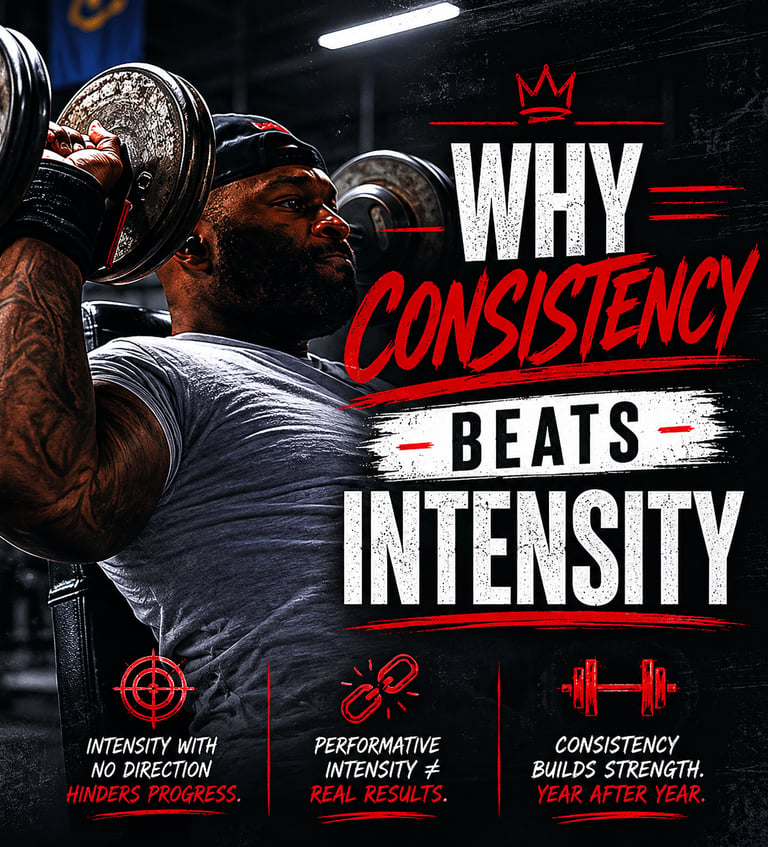
Why Consistency Beats Intensity
Walk into almost any gym and you’ll see it.
Someone is trying a crazy new exercise they saw online. Someone is maxing out every week. Someone is throwing weight around with questionable form because it looks impressive on camera.
The fitness industry has become obsessed with intensity.
The problem is that intensity by itself doesn’t guarantee results.
In fact, intensity without direction is often one of the fastest ways to slow down your progress, burn yourself out, or get injured.
I believe one of the biggest mistakes people make is being more performative with their intensity than productive with their training.
A lot of people want to look like they’re training hard instead of actually training smart.
There’s a difference.
The Problem With Chasing Intensity
Many lifters treat every workout like it needs to be a highlight reel.
They constantly max out, take every set to complete failure, add unnecessary complexity to their workouts, and perform exercises simply because they look cool on social media.
The problem is that your body doesn’t care how impressive your workout looks.
Your muscles don’t know whether an exercise is trending online.
Your body only responds to proper training stimulus, recovery, and progression over time.
Just because something looks cool doesn’t mean it’s beneficial for growth and gains.
In many cases, the flashy exercise is actually less effective than the basics people have been doing successfully for decades.
Consistency Builds Strength
The strongest people in the world aren’t the people who train the hardest for one week.
They’re the people who train consistently for years.
Strength is built through repetition.
Muscle is built through repetition.
Skill is built through repetition.
Showing up four days per week for a year will almost always produce better results than training seven days per week for a month and then quitting because you’re exhausted.
The boring workouts often produce the best results.
The workouts where you follow the plan, execute with good technique, and gradually improve are the ones that lead to long-term success.
Intensity Needs Direction
This doesn’t mean intensity is bad.
Intensity absolutely has its place.
When you’re pushing heavy squats, attacking a top set, grinding through a difficult deadlift, or trying to break a personal record, intensity matters.
But intensity must serve a purpose.
Every hard set should move you closer to a goal.
If you’re constantly pushing hard without a plan, you’re simply creating fatigue.
Fatigue is not the same thing as progress.
A productive training session isn’t measured by how destroyed you feel afterward.
It’s measured by whether it moved you closer to your goal.
The Injury Trap
One of the fastest ways to derail progress is getting injured.
Many injuries come from ego-driven training.
People load too much weight on the bar too quickly.
They sacrifice technique for heavier numbers.
They chase intensity instead of mastery.
The funny thing is that the lifter who spends time perfecting technique often becomes stronger than the lifter who rushes the process.
Mastering movement allows you to train consistently.
And consistency is where real progress happens.
My Philosophy
I’ve spent years in powerlifting, and one lesson keeps proving itself over and over again:
Consistency beats intensity.
I would rather see someone perform good squats every week for a year than perform one insane squat workout that gets thousands of views online.
The goal isn’t to impress people.
The goal is to get stronger.
The goal is to build muscle.
The goal is to make progress.
Intensity can be a powerful tool, but without direction it’s just noise.
The people who achieve the most in the gym are usually the ones who keep showing up, keep improving, and keep stacking small wins over time.
Because at the end of the day, the workout that changes your body isn’t the one you do once.
It’s the one you’re willing to do consistently for years.