
Why Linear Progression Is Superior to RPE
Ronnell "Kilo Nellz" Leftwich
5/15/20262 min read
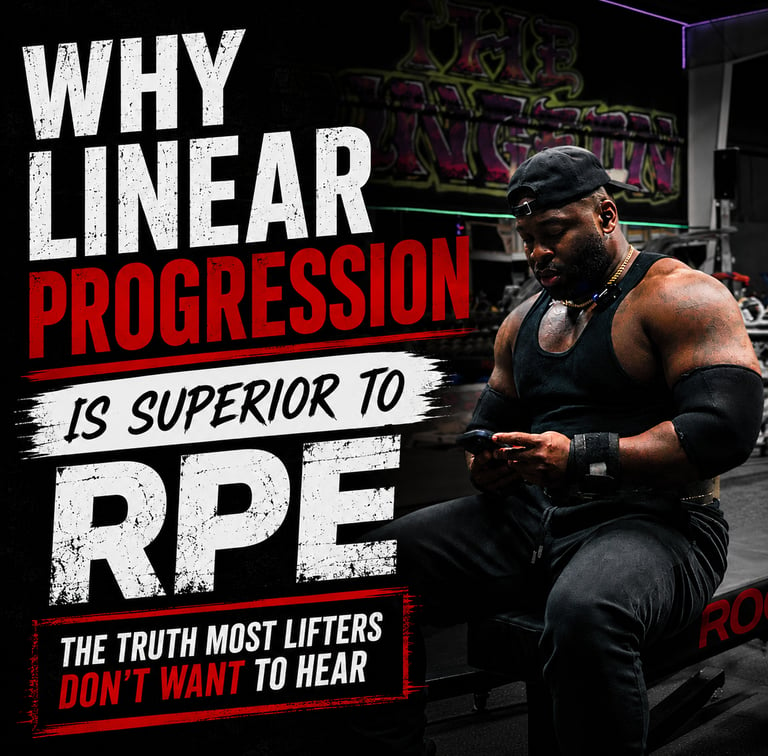
Why Linear Progression Is Superior to RPE
One thing I’ve noticed in today’s lifting culture is that everybody wants to overcomplicate training. Every week there’s some fancy system, some scientific buzzword, or some trend that people swear is the key to getting stronger.
Personally, I think RPE is overrated for most lifters.
Not because the concept itself is completely useless, but because most people are not experienced, disciplined, or honest enough with themselves to actually use it correctly.
That’s the part nobody wants to talk about.
Most lifters today are beginners or intermediates pretending to train like advanced lifters. They see elite-level athletes using RPE systems and think they should do the same thing, but they skip over one important detail:
Those elite lifters earned the experience necessary to accurately judge effort levels after YEARS under the bar.
Most people have not.
Most Lifters Misjudge Their Effort
I see it all the time.
Somebody says a set was an “RPE 8,” but the speed of the lift says otherwise. Either the weight moved way too easily, or they completely overshot and turned the set into an all-out grinder while still claiming they had “2 reps left.”
That’s the problem with RPE.
It depends heavily on self-awareness, experience, emotional control, and honesty.
Most lifters don’t have all four.
Some people underestimate because their confidence is low.
Some people overestimate because their ego is high.
Some people simply don’t know what true failure actually feels like.
And because of that, their progression becomes inconsistent.
Linear Progression Removes The Guesswork
This is why I will always stand behind linear progression.
Linear progression is simple:
Add weight over time.
Progress gradually.
Track performance honestly.
Get stronger.
There’s no guessing.
There’s no emotional attachment.
There’s no “I think this felt like an 8 today.”
The bar either moved better than last week or it didn’t.
That simplicity is powerful.
Especially for newer lifters.
Instead of trying to auto-regulate every single workout based on feelings, linear progression teaches discipline, consistency, and objective progress tracking.
It builds confidence because the lifter can physically SEE progress week after week.
Strength Is Built Through Consistency
A lot of lifters today are chasing complexity instead of mastering the basics.
But the basics are what build real strength.
Adding 5 pounds consistently over time may not look flashy on Instagram, but over months and years, it creates monsters.
Linear progression forces lifters to focus on execution, technique, recovery, and consistency instead of obsessing over trying to perfectly rate every set.
And honestly, most people would make far better progress if they stopped overthinking training and just focused on progressively getting stronger.
RPE Has Its Place — But Most People Aren’t Ready For It
Now, can RPE work?
Sure.
But in my opinion, it works best for highly advanced lifters who truly understand their bodies, understand fatigue management, and have enough experience to accurately judge intensity.
That’s a small percentage of people.
Most lifters are better off keeping things straightforward and measurable.
The truth is:
You don’t need to complicate training to get brutally strong.
You need consistency.
You need structure.
You need progression.
And you need honesty.
Click the link to get stronger now!